> For the complete documentation index, see [llms.txt](https://docs.gridplus.io/llms.txt). Markdown versions of documentation pages are available by appending `.md` to page URLs; this page is available as [Markdown](https://docs.gridplus.io/apps-and-integrations/lattice-manager.md).
# Lattice Manager
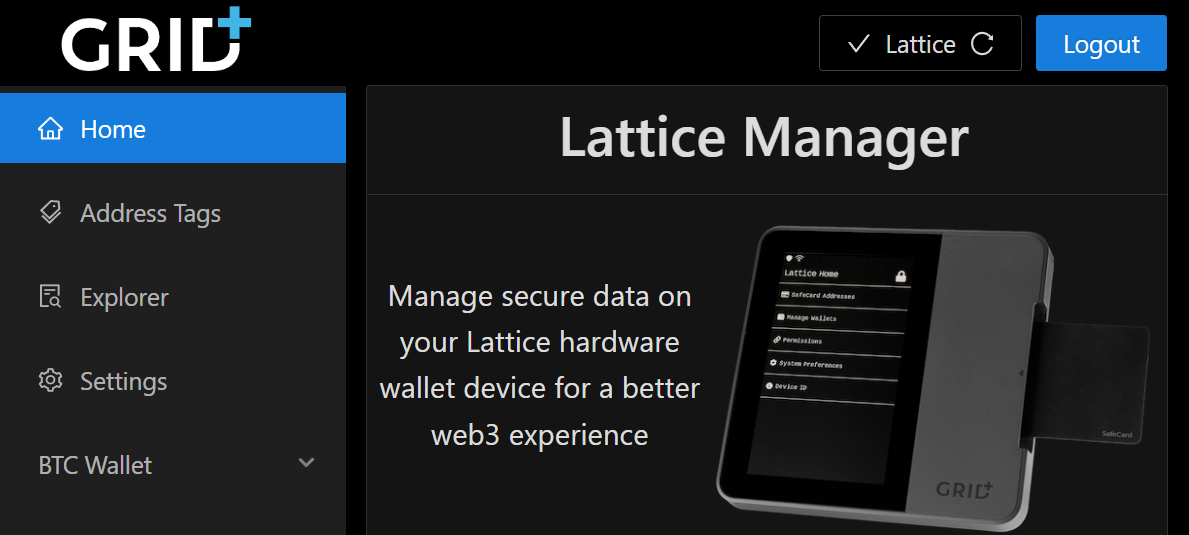
The [**Lattice Manager**](https://lattice.gridplus.io) is a **GridPlus web tool** which provides an interface for managing your Lattice. You can also use it to send simple Bitcoin transactions (as well as receive BTC) - for Ethereum operations, we recommend using the Lattice with [**MetaMask**](https://docs.gridplus.io/apps-and-integrations/metamask)**,** [**Frame**](https://docs.gridplus.io/apps-and-integrations/frame)**,** [**Rabby** ](https://docs.gridplus.io/apps-and-integrations/rabby)or [**Eidoo** ](https://docs.gridplus.io/apps-and-integrations/eidoo-app-mobile)(on mobile).
### Features
So, what can you actually do with the Lattice Manager?
**Address Tags**
Address Tags allow you to set a **custom display name** to any address that will be displayed on your Lattice screen instead of the standard 0xabc address format when approving transactions - this is very useful as it makes confirming that you're sending to the correct address much quicker, easier and with less room for error. Very powerful security feature, especially when combined with the [**automatic ABI decoding**](https://docs.gridplus.io/lattice1/how-the-lattice1-makes-transactions-readable-with-abi-decoding) that works on the Lattice. **Read more here:**
{% embed url="" %}
**Wallet Explorer**
The Wallet Explorer is a simple tool designed for exploring all the addresses derived from your wallet's seed phrase - using multiple and even custom derivation paths. You can also create custom address tags for each address directly in the Wallet Explorer interface. **More here:**
{% embed url="" %}
**Bitcoin Wallet**
The Lattice Manager also comes with a simple BTC wallet interface that allows you to **send and receive** BTC transactions - all three commonly used **address formats** (1, 3, bc1) are supported.
{% hint style="info" %}
The BTC Wallet is **hidden by default**, you have to switch to the address format you want to use it with in **Settings** if you're a first-time user. We recommend using [**NuFi**](https://docs.gridplus.io/apps-and-integrations/nufi/connecting-to-nufi) for your Bitcoin. The Lattice Manager BTC wallet works just fine, but might be retired in the future.
{% endhint %}
**You can find more information about the BTC interface here:**
{% embed url="" %}
**Settings**
Here you can manage connections to 3rd party apps (do not confuse this with the **Permissions** you can find on your Lattice), change the BTC wallet address format and also setup **your own message routing infrastructure** if you don't want to use ours - see **the article below for a guide!**
{% embed url="" %}
### Connecting to the Lattice Manager
1\. Go to the **Lattice Manager website:**
{% embed url="" %}
2\. Enter your **device ID**, which can be found on your Lattice1 by going to the Device ID page from your main menu. Enter any **password** you like. Press **Connect**.

3\. This will take you to the next step - you will see a new screen asking you to enter **a secret**, which should be now displayed on your Lattice screen. After you type in the correct secret, **the Lattice Manager will be paired to your Lattice1**. This will also create a new Lattice Manager **permission** on your device.
{% hint style="success" %}
If you **forget your password**, you can always remove the Lattice Manager permission on your Lattice by going to **Permissions → Lattice Manager → Delete** and re-connect by going through these steps again.
{% endhint %}
**And you're done with the setup!**